List of contents
Discover the AI powered personalisation tool
See a DemoHow to Solve the 10 Things Broken with eCommerce
Download GuideWhy Personalisation and Merchandising Usually Conflict (And What to Do About It)

List of contents
Every retailer eventually runs into the same argument, even if nobody phrases it this way. Someone in merchandising wants a specific product in a specific spot — a clearance line pushed higher, a new arrival given room to breathe, a strategic brand kept visible no matter what the algorithm thinks of it. Someone else wants the site to adapt to the person looking at it — to stop showing a hiking boot to someone who's never bought outdoor gear. Both are right. Most tools can only give you one of them.
That's the core tension. Merchandising tools are built around what the business needs to sell: rules, priorities, guaranteed placements. Personalisation tools are built around statistical relevance to an individual: what this person is likely to want, based on everyone like them. Put a rules engine and a personalisation engine on the same shelf and they will fight over it, because they were never designed to share it.
Three ways the conflict shows up
We see this play out the same way, retailer after retailer, once you know what to look for.
The first is the pin that doesn't hold. A merchandiser locks a product into position — this season's hero piece, an overstocked line that needs to move — and within a few days it's drifted, because the personalisation layer has quietly reordered around it for every visitor it judges won't respond to it. Nobody switched anything off. The two systems are just running on separate logic, and the one built to react continuously usually wins by default over a rule that was only ever set once.
The second is the opposite failure: personalisation gets switched off entirely because it's too hard to reconcile with business priorities. We've seen retailers running two separate tools just to handle one narrow job each — one to push out-of-stock items to the bottom of a category page, another attempting personalisation on top — quietly cancelling each other out until someone gives up and turns the personalisation off. The site reverts to a single fixed sort, the same shelf for every visitor, because that's the only version everyone could agree wouldn't break something else.
The third is subtler and more expensive: constant manual patching. A merchandising owner rebuilds a category page by hand because an automated sort scattered a set of products that were shot and priced together, or reordered a curated list in a way nobody signed off on. It isn't a one-off fix — it's a job someone repeats every time priorities shift, which in retail is constantly.
None of this is a tooling failure in the usual sense. It's an architecture failure. Most merchandising tools and most personalisation tools were built by separate teams solving separate problems, then connected at the point of sale, if they're connected at all. The rules layer and the relevance layer never actually share a model of the customer or the catalogue — they're just taking turns overwriting each other's output.
What actually fixes it
The fix isn't picking a winner. It's changing the question from "rules or AI" to "rules and AI, applied to the same shared understanding of both sides." A few things follow from that.
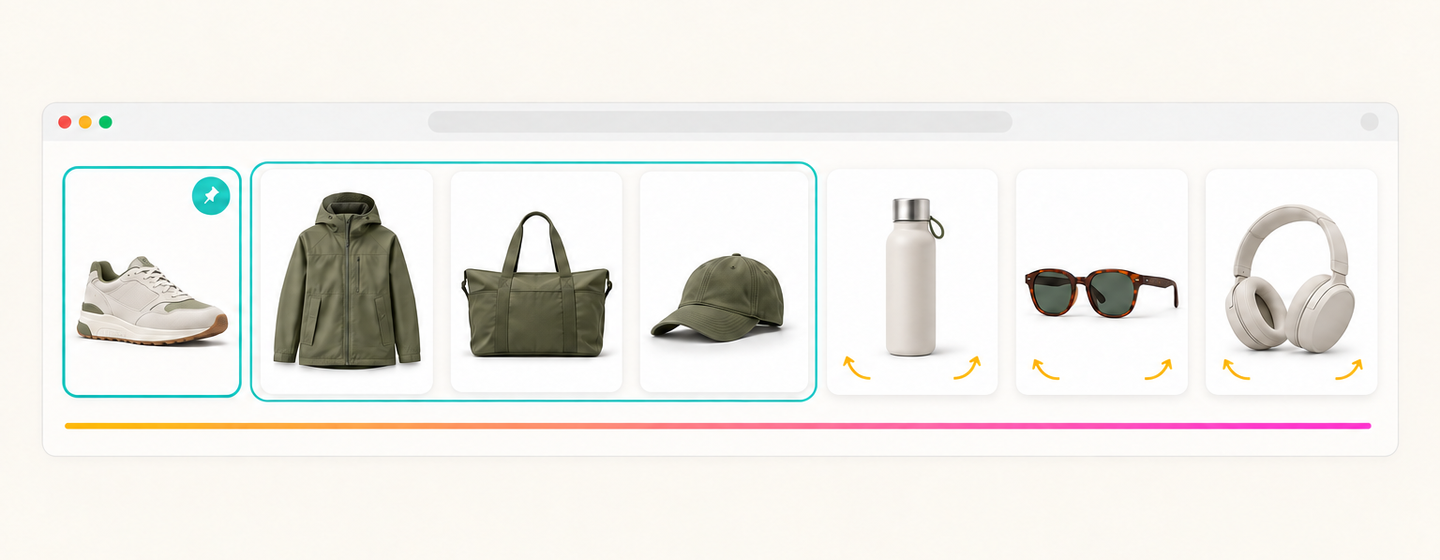
Guarantee what needs to be guaranteed, and let everything else move. Not every decision needs a rule. The ones that do — a hero product in position, a category that must stay visible regardless of what's trending — should be genuinely fixed, not a strong suggestion the algorithm is free to override. Everything else should be free to personalise around those fixed points, for every visitor, from the first click.
Guarantee at the group level, not just the SKU. A single pinned product solves one problem. It doesn't solve the more common one: products that belong together — same line, same photoshoot, same brand story — scattering across the page as an automated sort reorders everything around them individually. That's a distinct kind of guarantee, and most tools don't offer it, because most sorting logic only ever looks at one product at a time.
Treat it as a live decision, not a project. The conflict gets worse the longer the gap between "the business decided this matters" and "the site reflects it." If changing a priority means a ticket, a sprint and a release window, the business will eventually stop bothering to use the rules at all — which is how you end up back at a single fixed sort by default.
The retailers who get past this aren't the ones who pick personalisation over merchandising, or the other way round. They're the ones who stop treating them as two tools competing for the same page, and start treating them as two views of the same problem: what does this business need to sell, and what does this specific person actually want — answered together, continuously, down to the SKU.
Want to see merchandising and personalisation working together on your store? Book a 30-minute demo.
Share:


.png)