
List of contents
Discover the AI powered personalisation tool
See a DemoHow to Solve the 10 Things Broken with eCommerce
Download GuideTop 5 Things You Hate About Search (And How Shopbox Fixes Them)

List of contents
If you work in ecommerce, there's a specific kind of frustration that's almost become wallpaper.
It's the moment a shopper types something completely reasonable into your search bar — and gets nothing back. Or the moment you realise your new product launch got zero organic traffic from your own site because it wasn't tagged perfectly. Or the moment someone on your team explains, for the third time this quarter, that they're spending two days a week managing synonym rules.
We talk to retailers every week. And the same complaints come up, again and again. So here they are — the five things everyone hates about ecommerce search — and what actually fixes them.
1. It Returns What You Typed, Not What You Meant
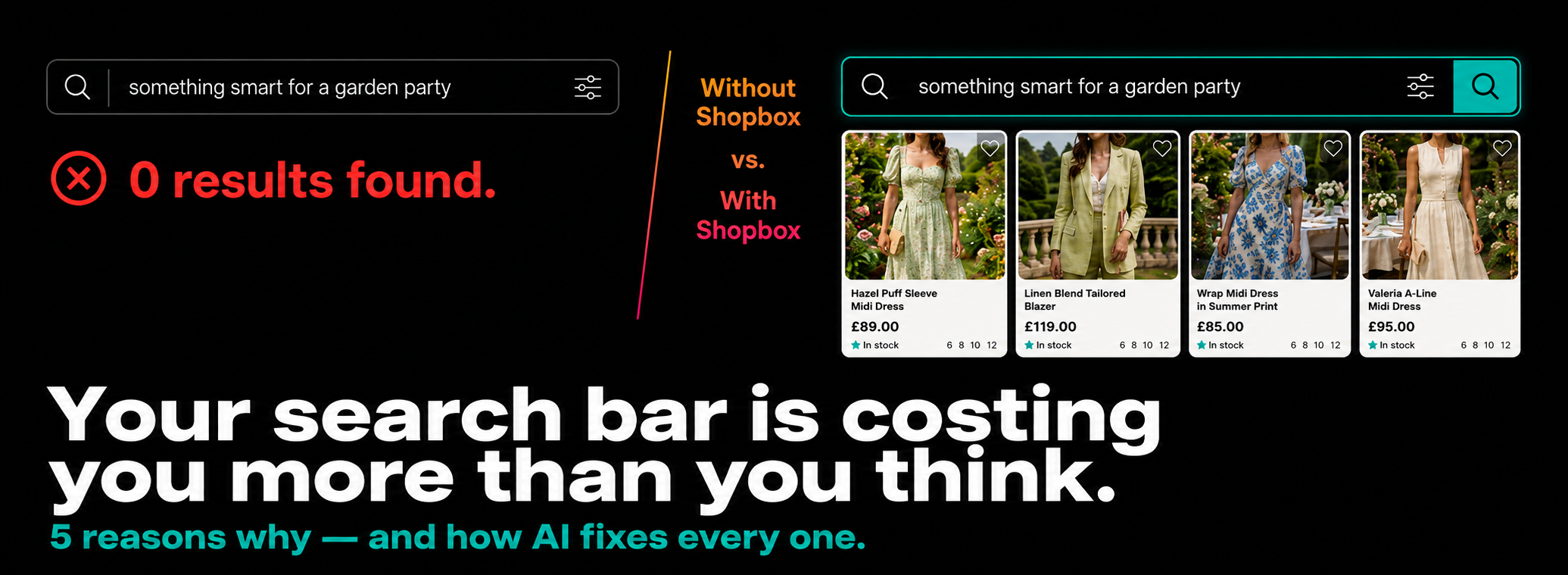
A shopper lands on your store. They're looking for something to wear to a summer wedding — not a product name, not a category code, just a description of what they need. They type: "something smart for a garden party."
Your search bar looks for "smart" and "garden party." It finds nothing. Or worse, it surfaces garden tools.
This is the defining failure of traditional site search. It was built to match strings. It does exactly what it was designed to do — and that design is twenty years out of date. Shoppers don't search in product taxonomy. They search the way they think. They use questions, descriptions, moods, and context.
Research from the Baymard Institute has consistently shown that the majority of ecommerce sites fail to handle non-keyword queries — the symptom searches, use-case searches, and descriptive queries that represent how real shoppers actually browse. The result isn't just a poor experience. It's a missed sale, every single time.
How Shopbox fixes it: Shopbox AI Search is built on semantic understanding, not keyword matching. It reads the intent behind a query from the first keystroke — not the literal words, but what the shopper is actually trying to find. Natural language, incomplete phrases, descriptive searches — all handled, all the time, without any manual configuration.
2. Zero Results Pages That Kill Conversions
"No results found."
Four words that should never appear on a well-run ecommerce site. And yet, for most retailers, they appear every single day — on typos, on shorthand, on perfectly reasonable product descriptions that just don't match an exact catalogue tag.
Every zero results page is a moment where a high-intent shopper — someone who has arrived on your site, chosen to search, and told you exactly what they want — is told to go away and try again. Most don't. They leave. And because this happens quietly, buried in analytics most teams never look at, it compounds for months or years without anyone fixing it.
The traditional fix is more manual work: synonym rules, redirect rules, query overrides. Someone has to own the list. Someone has to update it. And it never quite keeps up.
How Shopbox fixes it: Shopbox handles typos, synonyms, and intent gaps automatically. If a shopper searches for "trainers" on a site that catalogues them as "sneakers," Shopbox knows. If someone types "treadmil" instead of "treadmill," Shopbox knows. If someone searches for something adjacent to a product rather than the product itself, Shopbox knows. The zero results page stops being a thing your team has to manage — because the AI does it, without a list, without rules, without maintenance overhead.
3. It Ignores Who's Searching
Here's something that should feel obvious but rarely is: the same search query means different things, depending on who's typing it.
A first-time visitor typing "running shoes" is probably at the start of a research journey. A returning customer who just bought a treadmill last month and is now typing the same thing is probably looking for something specific — a training shoe that works on the machine they just purchased. A customer who has been browsing trail gear for the last ten minutes is probably looking for something completely different again.
Traditional search doesn't know any of this. It returns the same results for "running shoes" regardless of who's searching, what they've looked at, how many times they've visited, or where they are in their decision. It treats every search as if it's the first search, from an anonymous stranger, with no context and no history.
That's a significant amount of commercial intelligence being left on the table.
How Shopbox fixes it: Shopbox personalises results per visitor, not just per query. Every search is informed by what that specific shopper has browsed, interacted with, and shown interest in — from the very first session, even before they've logged in. Two people can type the same thing and get different, individually relevant results, because they're different people with different intent. This is the difference between a search bar and a shopping assistant.
4. New Products Get Buried
You've just launched a new collection. The campaign is live, the ads are running, the product is in stock — and then a shopper searches for exactly the category it sits in, and it appears on page three.
This is one of the most quietly costly problems in ecommerce merchandising. New inventory doesn't have the engagement history, click data, or conversion signals that your established bestsellers do. So AI systems that rank purely by performance signal will, by design, suppress new products in favour of proven ones. The longer a product sits without surface time, the less data it accumulates — and the more invisible it stays. It's a loop that's almost impossible to break without intervention.
The result is that new launches underperform their actual potential, not because shoppers don't want them, but because the search layer never gives them a fair chance.
How Shopbox fixes it: Shopbox gives your merchandising team control over what gets surfaced and when — so a new launch gets shown to relevant shoppers from day one, not after three months of quiet obscurity. The AI handles relevance. Your team sets commercial priorities. Both work together without one overriding the other. New products get a fair chance. Your campaigns land the way they were meant to.
5. It Takes Months to Set Up and Tune
The final frustration is the one that stops a lot of retailers from doing anything about the other four.
Traditional enterprise search implementations are long projects. There's integration work, data mapping, taxonomy alignment, synonym library setup, relevance tuning, QA cycles, and usually a period of post-launch fixes when the first wave of real traffic hits. By the time it's working the way you hoped, six months have passed, your team is exhausted, and you're already being told the next version will require another integration cycle.
The inertia this creates is real. Retailers know their search is broken. They've known for a long time. But the perceived cost and effort of fixing it — especially when the business is busy — means it keeps getting pushed to the next quarter, and the next one after that.
How Shopbox fixes it: Shopbox is live in hours, not a six-month implementation project. For retailers on Shopify, go-live is typically under an hour. No extended IT resource. No lengthy data migration. No synonym library to build before you can go live. The AI learns from your catalogue and your shoppers from the moment it switches on — and it keeps improving without manual input.
This is probably the thing that surprises retailers most when they first see it in action: not that it works, but that it works this quickly.
The Pattern Across All Five
Reading back through these five frustrations, something becomes clear.
Every one of them shares the same root cause: traditional search was built to process queries, not to serve shoppers. It's a lookup tool that never got updated to behave like a selling tool.
Each Shopbox fix addresses a different symptom of that same underlying problem. Semantic understanding fixes the intent gap. Automatic synonym handling fixes the zero results problem. Visitor-level personalisation fixes the anonymous search problem. Merchandising control fixes the new product visibility problem. And fast implementation fixes the inertia problem.
None of these should require a six-month project, a dedicated synonym manager, or a team that spends its time patching the gap between what shoppers mean and what your engine understands.
They should just work.
Want to see what this looks like on your catalogue? Shopbox is live in under an hour. Book a demo and we'll show you exactly what it does on your store.
Share:



.png)
.png)


