List of contents
Discover the AI powered personalisation tool
See a DemoHow to Solve the 10 Things Broken with eCommerce
Download GuideBig Platforms Aren't Fit for Purpose for a Lot of Retail Tooling — The Issue Is Speed

List of contents
Retail runs in real time. A competitor drops their price this afternoon. A product goes unexpectedly viral over a weekend. A supplier delay leaves a category thin on stock by Tuesday. None of that waits for a release window. And yet a huge amount of the tooling retailers rely on to react to exactly these moments is built on a cycle measured in quarters, not hours — which means that by the time the fix ships, the moment it was meant to address has already passed.
This isn't really an argument against big platforms doing what they do well — stability, scale, a dependable core for the transactional plumbing of a store. It's an argument that a lot of the tooling built on top of, or bolted onto, those platforms inherited the platform's pace rather than retail's. And retail's pace isn't quarterly. It's daily, sometimes hourly.
Where the cost actually shows up
The clearest version of this shows up in the smallest, most repetitive jobs. We've talked to merchandising teams who rebuild a single category page by hand — a fifteen-hour job, repeated every time a stakeholder changes their mind about what should be featured — because the tooling available to them can't take "here's what matters this week" as an input and just do it.
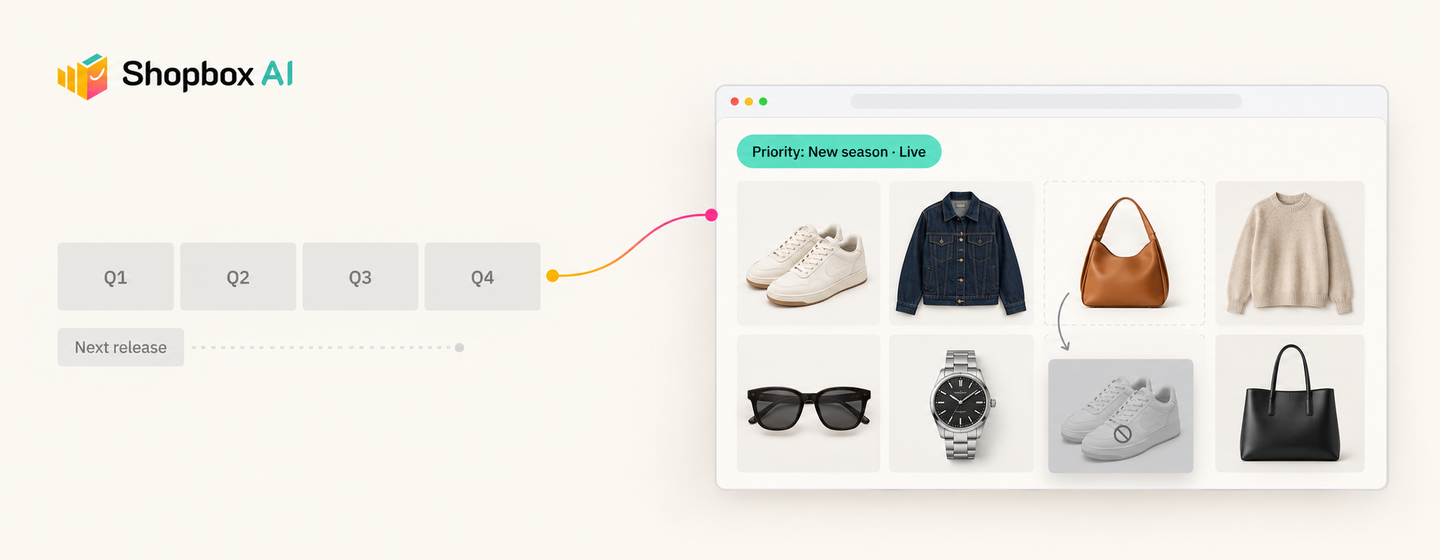
We've seen retailers running an entire separate app just to handle one narrow task, like pushing out-of-stock products to the bottom of a page, because the platform's native sort can't do it and a proper merchandising layer was too heavy a project to justify. Multiply that across every category, every season, every promotional moment, and a merchandising team's actual job quietly becomes working around what the tooling can't do, rather than making the calls that matter.
"Wait for the next release" is still waiting
The deeper issue is what counts as "done" for most of this tooling. A big platform ships a genuinely useful native feature — a smarter collections model, better native sorting — and it's real progress. But it still ships on the platform's release cadence, not the retailer's, and it still tends to apply one decision to every visitor rather than adapting to who's actually looking. Waiting for the next platform update to close a merchandising gap is still waiting. In a business where the shelf needs to change today, "wait for the next release" and "wait for a competitor to notice" are functionally the same sentence.
This is where the real cost of slow tooling shows up — not in the big, obvious failures, but in the daily erosion of a team's ability to act on what it already knows. A merchandiser who can see a category underperforming, or a line about to be caught out of stock, or a trend worth leaning into, but has to file a ticket and wait for a sprint to do anything about it, isn't really equipped — they're informed and blocked at the same time. Any tool that turns "I need to change this" into a project rather than an action has already missed the window it exists to serve.
What fit for purpose actually looks like
For the tooling layered on top of a retail platform, "fit for purpose" is simple to describe and hard to build: a change should be an input, not a project. A merchandiser sets a priority and it's live in minutes. A rule gets adjusted the same day a stock position changes, not the next sprint. The tooling sits alongside the core platform without requiring a re-platform or a multi-week integration to add or change, so the decision to act and the ability to act happen close together, the way they need to in a business that moves this fast.
The platforms themselves aren't going anywhere, and shouldn't. But retailers evaluating what to build or buy on top of them should be asking a sharper question than "does this do what we need." They should be asking how long it takes, in practice, to change what it does. A tool that takes a quarter to adjust was already too slow for the business it was sold into. Retail doesn't really run on projects any more. It runs on decisions, and they need to ship the same day they're made.
Frequently asked questions
Why are big ecommerce platforms too slow for retail tooling?
Because much of the tooling built on top of, or bolted onto, those platforms ships on the platform's release cadence, which is measured in quarters, while retail decisions need to happen daily or even hourly. By the time a fix ships, the price drop, viral product or stock gap it was meant to address has usually passed.
What does "fit for purpose" mean for retail merchandising tools?
It means a change is an input, not a project. A merchandiser sets a priority and it's live in minutes, a rule is adjusted the same day a stock position changes, and the tool sits alongside the core platform without a re-platform or a multi-week integration to add or change it.
Should retailers wait for native platform features to close merchandising gaps?
Native features such as smarter collections or better sorting are real progress, but they still ship on the platform's timeline rather than the retailer's, and they usually apply one decision to every visitor instead of adapting to who's actually looking. Waiting for the next release is still waiting.
What is the hidden cost of slow merchandising tooling?
It's rarely a big, obvious failure. It's the daily erosion of a team's ability to act on what it already knows: category pages rebuilt by hand, separate apps run just to push out-of-stock products down a page, and merchandisers who can see what needs changing but have to file a ticket and wait for a sprint.
What should retailers ask when choosing tools to build or buy on top of their platform?
Beyond "does this do what we need," ask how long it takes, in practice, to change what it does. A tool that takes a quarter to adjust is already too slow for a business that runs on same-day decisions.
Share:


.png)