List of contents
Discover the AI powered personalisation tool
See a DemoHow to Solve the 10 Things Broken with eCommerce
Download GuideWhich Tools Offer AI Product Recommendations for Shopify?

List of contents
Plenty of tools offer AI product recommendations on Shopify. Shopify's own Search & Discovery app is free. Upsell apps like Wiser, Glood and LimeSpot cost little. Rebuy covers cart and checkout. Nosto, Athos Commerce (Searchspring and Klevu) and Dynamic Yield are bigger platforms. The real question: does a tool add a widget, or change the whole store for each shopper?
I get asked this question a lot, usually by someone who already has two recommendation apps installed and isn't sure either is doing anything. So here's the honest list, plus the one test I'd use to choose between them.
What's the difference between a recommendation widget and personalisation?
Most "AI recommendations" are product-to-product. You look at a blue water bottle and the carousel says "you may also like" five more water bottles. "Customers also bought" a lead. Everyone who lands on that product page sees roughly the same thing.
That's useful. But it isn't learning anything about you. It's product-level: if you saw this product, here's another product. It doesn't know anything about you as a customer.
Personalisation works the other way round. It starts with the person and rebuilds the store around them: homepage, collection pages, search results, the lot. You market to segments, but you sell to people. Segmentation is a great marketing tool. It's a terrible sales tool.
Think about a DIY store. Two people walk in on the same Saturday morning. Same age, same postcode, same segment on paper. One is tiling a bathroom and needs adhesive, spacers and a wet saw. The other is fixing a fence after a storm and needs posts, postcrete and screws. Show them both "popular in DIY" and you've helped neither. A good person on the shop floor would have them sorted in two minutes, because they'd respond to what each one is actually doing.
If you have a million customers, there should be a million completely different views of your store, adapting over time. A school supplies retailer made the same point to me recently. Two teachers in the same school, with kids the same age, can have completely different needs if one teaches children with specific needs. Same segment on paper. Two different people in real life.
Does it actually matter for revenue?
Yes, and the numbers have been consistent for a while. McKinsey's Next in Personalization report found that personalisation most often drives a 10–15% revenue lift. It also found 71% of consumers expect personalised interactions, and 76% get frustrated when they don't get them. It's from 2021, so treat it as the classic benchmark, but nothing since has contradicted it.
Our own data says the same. Across five Shopbox retailers we looked at in October 2026, shoppers who clicked a personalised product converted more than five times better than those who didn't. Those shoppers were already keen, of course, so that's not all down to personalisation. But it shows the point: when people engage with relevant products, they spend.
And shoppers say they want it. A 2024 Forbes survey cited by Shopify found 81% of customers prefer companies that offer personalised experiences. The same Shopify piece cites Acxiom's 2024 research: 51% of consumers like tailored offerings, yet only 13% of brands use predictive personalisation. That gap is the opportunity.
Which tools offer AI product recommendations for Shopify?
Here's a fair rundown by category, based on what each vendor says publicly as of October 2026.
Shopify's own recommendations (free)
Shopify generates "related products" automatically using purchase history, product descriptions and related collections. "Complementary products" are ones you pick by hand, up to 10 per product. The free Search & Discovery app lets you edit them and see click-through. They show on product pages only, and they're the same for every visitor. Start here if you have nothing.
Upsell and cross-sell apps
- Wiser: related, recently viewed, "frequently bought together", cart drawer and post-purchase widgets.
- Glood: trending, bestseller and recently viewed widgets, with more personalised widgets on the higher plans.
- LimeSpot: upsells and bundles from homepage to checkout, with audience segmentation and A/B testing on the top plan.
These are quick to set up and good at what they do: adding more to the basket. They're widgets.
Cart and checkout recommendations
Rebuy Smart Cart, bundles, checkout and post-purchase offers. It's product recommendations around the basket, built on rules and widgets you configure. That's powerful, but it needs a fair amount of setup and someone to manage it, deciding which offers show where and keeping them current.
Bigger recommendation and discovery suites
- Nosto: at its core, product recommendations, plus search and category merchandising. Its category merchandising shows different collection views to different segments, which means building and maintaining those segments and the rules behind them. Expect setup time and ongoing management.
- Athos Commerce: formed in January 2025 when Searchspring and Klevu combined. Search-led, with recommendations and merchandising alongside. Powerful in the right hands, and those hands need to be on it regularly.
- Dynamic Yield by Mastercard: enterprise experimentation, recommendations and A/B testing. Built for large brands, and in general it will need a lot of developer time to implement and run.
Shopbox AI
That's us, so I'll keep it short and honest in a section further down.
How should you judge them?
Ignore the AI badge. Every app has one now. Ask these four questions instead.
1. Does it change collection pages and search, or just add a carousel?
Collection pages are where shoppers actually browse. Baymard's 2025 product list research found 80% of sites have serious product list issues. A carousel on the product page doesn't fix a collection page that shows everyone the same 48 products in the same order.
2. Does it work from the first click?
This is the one most people miss. Most of these tools take time to learn about a customer. Some need a first purchase, or a sign-up, before they really start to personalise. Until then, everyone gets bestsellers.
That misses most of your traffic. Most visitors are anonymous, arrive on a product page from an ad or Google, and many never come back. If the tool only wakes up after someone has bought from you, it's personalising for the people who needed it least.
The bar should be one click. One click is enough to start understanding what someone is shopping for and rebuild the store around them. Ask every vendor to show you what happens after a single click, not after six months of history.
Training time matters too. Ask how long the AI needs to learn your catalogue before it's any good. If it needs weeks or months of data to learn, it will always be selling last season. By the time it has worked out your new range, you're already into the next one, and the mid-season drop has come and gone.
3. Does it respect what your merchandisers want?
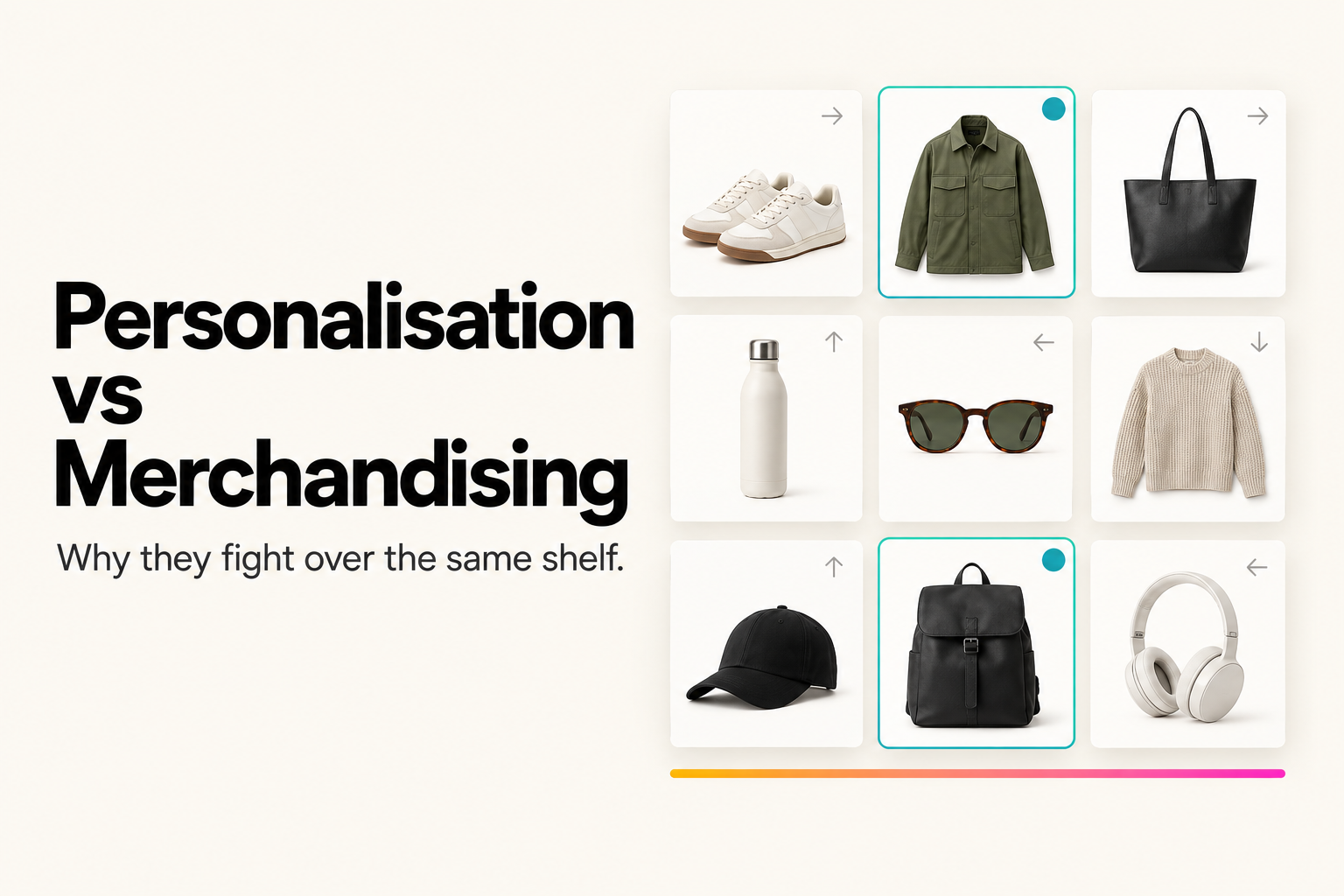
A lot of personalisation just pushes bestsellers, which often works against the merchandiser. New season launches don't have sales data yet. Neither do slow movers you need to shift. And timing is everything: nobody can sell heart-shaped stuff on the 15th of February. Personalisation should be helping your events, not off doing its own thing. More on that in personalisation vs merchandising.
4. How long until it's live, and who maintains it?
Some tools are live in an afternoon. Some are a three to six month project with rules, synonym lists and segment definitions to maintain forever. Count the people hours, not just the licence.
Why don't segments go far enough?
Here's a demo I run a lot, on a pet retailer's store. I search Google for a dog water bottle and land on the product page. First visit, no history.
Then I click around. The homepage now shows travel and cooling products, not five more water bottles. When I move into health and hygiene, a category with no water products in it at all, it picks up travel products for the dog: calming aids, protective boots, cooling mats. Most systems would give up at that point and show trending products.
That's the thing about people. There is no segment for "travelling with a dog that's also chewed its tail and needs some first aid". But that's a real customer, and they're on your site right now. The moment you combine two people together, you've created an average, and an average is wrong for both of them.
Do chatbots replace recommendations?
Not in my experience. One retailer we work with ran their own shopping chatbot alongside Shopbox. Over about six weeks, the chatbot drove roughly 10 product views. Shopbox's simple personalisation drove about 4,000 product views over the same period. Those are product views, not orders. But it tells you where shoppers actually engage: in the store, not in a chat window.
What can you do tomorrow, whatever tool you use?
Run the one-click test. Open an incognito window. Google one of your products and land on its page, like a new shopper from an ad would. Click once, then go to a collection page and the homepage. Did anything change? If not, your "AI recommendations" aren't recognising anyone.
Fill in complementary products for your top 20 sellers. It's free in Shopify's Search & Discovery app, takes an afternoon, and beats an empty slot. Hide anything you don't want pushed.
Check how your app measures itself. Many tools claim the whole order if the shopper touched a widget. Ask for product-level attribution: did they buy the product the tool showed them? If the numbers from all your apps add up to more than your revenue, someone is over-claiming.
Where does Shopbox fit?
Shopbox replaces simple recommendations with personalisation that understands every customer. It's one engine for Search, Personalisation and Merchandising, so everything works together seamlessly and each shopper gets a personal store across every surface: the homepage, collection pages, product pages and search results.
There are no segments or profiles to build, and no waiting for a first purchase or a sign-up. Shopbox predicts what a shopper is looking for from their first click with 70–80% accuracy, then keeps reassessing as they browse. It learns a new product as soon as it's in your catalogue, so new season gets airtime from day one instead of waiting for sales history.
Merchandisers stay in charge. In Merchandising Studio you lay out a collection the way you want it curated, and within that you tell it to find more profitable products for each customer. Relevance first, commercial priority second. With Presets, you can launch a whole Black Friday or Christmas strategy in one go and revert after.
Across deployments we see a 4–12% revenue uplift, verified at SKU level. Schuh has been a customer for four years and has just signed for year five, with over 60,000 orders a day on Black Friday. On Shopify we can be live the same day: we set it up on a copy of your store and you review it. No developer project. We also run on Shopify Plus, Magento, BigCommerce, Salesforce Commerce Cloud, WooCommerce and custom platforms.
If you want to see what one click does on your own catalogue, book a demo. I'll run the dog water bottle test on your store instead of ours.
FAQ
Does Shopify have built-in AI product recommendations?
Yes. Shopify automatically generates related products using purchase history, product descriptions and related collections, and you can hand-pick up to 10 complementary products per product in the free Search & Discovery app. They appear on product pages and are the same for every visitor, so they're a good starting point rather than full personalisation.
What's the best product recommendation app for a small Shopify store?
For smaller stores, low-cost apps like Wiser, Glood or LimeSpot are a sensible start. They add "frequently bought together", related and recently viewed widgets. Start with Shopify's free native recommendations, then add an app if you need cart and post-purchase upsells. Just remember these are widgets, not personalisation.
What's the difference between product recommendations and personalisation?
Product recommendations usually link product to product: if you viewed this, here's something similar. Everyone on that page sees the same thing. Personalisation starts with the shopper and changes what they see across the store, including collection pages and search, based on what they've done in that session.
Do AI recommendations work for first-time visitors?
Some do, many don't. Many tools need time to learn, and some need a first purchase or a sign-up before they really personalise. That misses most of your traffic, because most visitors are anonymous. Test it yourself: land on a product page in an incognito window, click once, then check whether the homepage and collection pages change.
How much revenue do product recommendations drive?
McKinsey found personalisation most often lifts revenue by 10–15%. Across five Shopbox retailers, shoppers who clicked a personalised product converted more than five times better. Across Shopbox deployments we see a 4–12% revenue uplift, verified at SKU level rather than by claiming whole orders.
Sources
- Shopbox analytics, 5–18 Oct 2026 — 5 retailers, bots excluded, revenue from checkouts matched to sessions: shoppers who clicked a personalised product converted a median 5.6x better (range 3.4–9.2x). Correlation, not lift.
- McKinsey: The value of getting personalization right—or wrong—is multiplying — 10–15% revenue lift, 71% expect / 76% frustrated. Published 12 Nov 2021 (classic benchmark).
- Shopify Enterprise: Personalization — Forbes 2024 (81% prefer personalised experiences); Acxiom 2024 (51% like tailored offerings, 13% of brands use predictive personalisation). Published 9 Jan 2025.
- Shopify Help: Customize product recommendations — how related/complementary recommendations are generated; 10-product limits. Accessed Oct 2026.
- Shopify App Store: Search & Discovery — free, features. Accessed Oct 2026.
- Shopify App Store: Wiser — features. Accessed Oct 2026.
- Shopify App Store: Glood — features. Accessed Oct 2026.
- Shopify App Store: LimeSpot — features, segmentation on top plan. Accessed Oct 2026.
- Rebuy — product areas. Accessed Oct 2026.
- Shopify App Store: Nosto — feature areas. Accessed Oct 2026.
- Nosto Help: Category merchandising on Shopify — segment-based category views. Accessed Oct 2026.
- Athos Commerce: Klevu joins forces with Searchspring — merger 13 Jan 2025, capabilities.
- Shopify App Store: Dynamic Yield by Mastercard — features. Accessed Oct 2026.
- Baymard: Product Finding 2024 launch — page links to "Product List UX 2025" finding that 80% of sites have serious issues. Published 17 Sep 2024.
Share: