List of contents
Discover the AI powered personalisation tool
See a DemoHow to Solve the 10 Things Broken with eCommerce
Download GuideBest Alternatives to Klevu for Ecommerce Search

List of contents
If you're on Klevu, you have a decision to make before 2027. Klevu is now part of Athos Commerce, which has said its legacy platforms will be gradually retired from 2027. You can take the Athos migration path, or use the moment to test alternatives like Algolia, Constructor, Bloomreach or Shopbox on your own search data.
That's the short version. Here's the longer one, from someone who sells one of those alternatives. So yes, I have a horse in this race. I'll try to be fair anyway.
What's actually happening to Klevu?
I've been saying to retailers this year that every Klevu customer is facing a big decision. I want to be careful here, because there's a lot of noise about it, so here's only what's on the public record.
- January 2025: Klevu combined with Searchspring to form Athos Commerce, backed by PSG. The announcement said Klevu served more than 3,000 brands. Athos's own blog said the deal closed on 9 January 2025 and that they were "taking the key features from both platforms to build into the new one."
- August 2025: Athos published a rollout plan. General availability of the new platform was set for Q1 2026, with "a clear upgrade path for Searchspring customers and a migration path for Klevu customers." Then the line that matters: "Beginning in 2027, legacy platforms will be gradually retired."
- June 2026: Athos launched its Intelligent Discovery Platform at Shoptalk Europe, saying it is "available immediately."
So Klevu customers will need to start migrating from early 2027. And "migration path" (rather than "upgrade path") tells you this isn't a button you press. It's a project.
To be fair to Athos, I think consolidating is the right call. Running two search engines side by side forever makes no sense for anyone. I said to my co-founder in July that I'd have loved to see better tools to help people port across. But the direction is sensible.
Should you move at all?
Here's the thing. You're going to migrate either way. Moving to Athos is still a migration. So the real question isn't "stay or go". It's "since I have to do the work anyway, is this the platform I'd pick today?"
Three questions help:
1. Are you happy with what you've got? I've heard from retailers more than once that Klevu's search was fine, but they were much less happy with the recommendations side. If that's you, the move is a chance to fix the weaker part, not just carry it across.
2. How much of your team's week goes into feeding the tool? Synonyms, redirects, boost rules, zero-result fixes. A retailer told me recently she'd used Klevu and Algolia in the past and her team simply couldn't keep up with them. Not because the tools were bad, but because she didn't have the people. Another prospect described legacy search as becoming "way too much of a resource drain."
3. What does your next two years look like? New markets, a replatform, a bigger catalogue? Pick something that fits where you're going, not where you've been.
What should you look for in a Klevu replacement?
Search matters more than most teams give it credit for. Across seven Shopbox retailers we looked at in October 2026, shoppers who used site search converted around six times better than those who didn't. And there's room to improve almost everywhere: Baymard's 2026 update found 56% of sites fail to adequately support users' search needs, with "feature", "use case" and "compatibility" searches the usual weak spots.
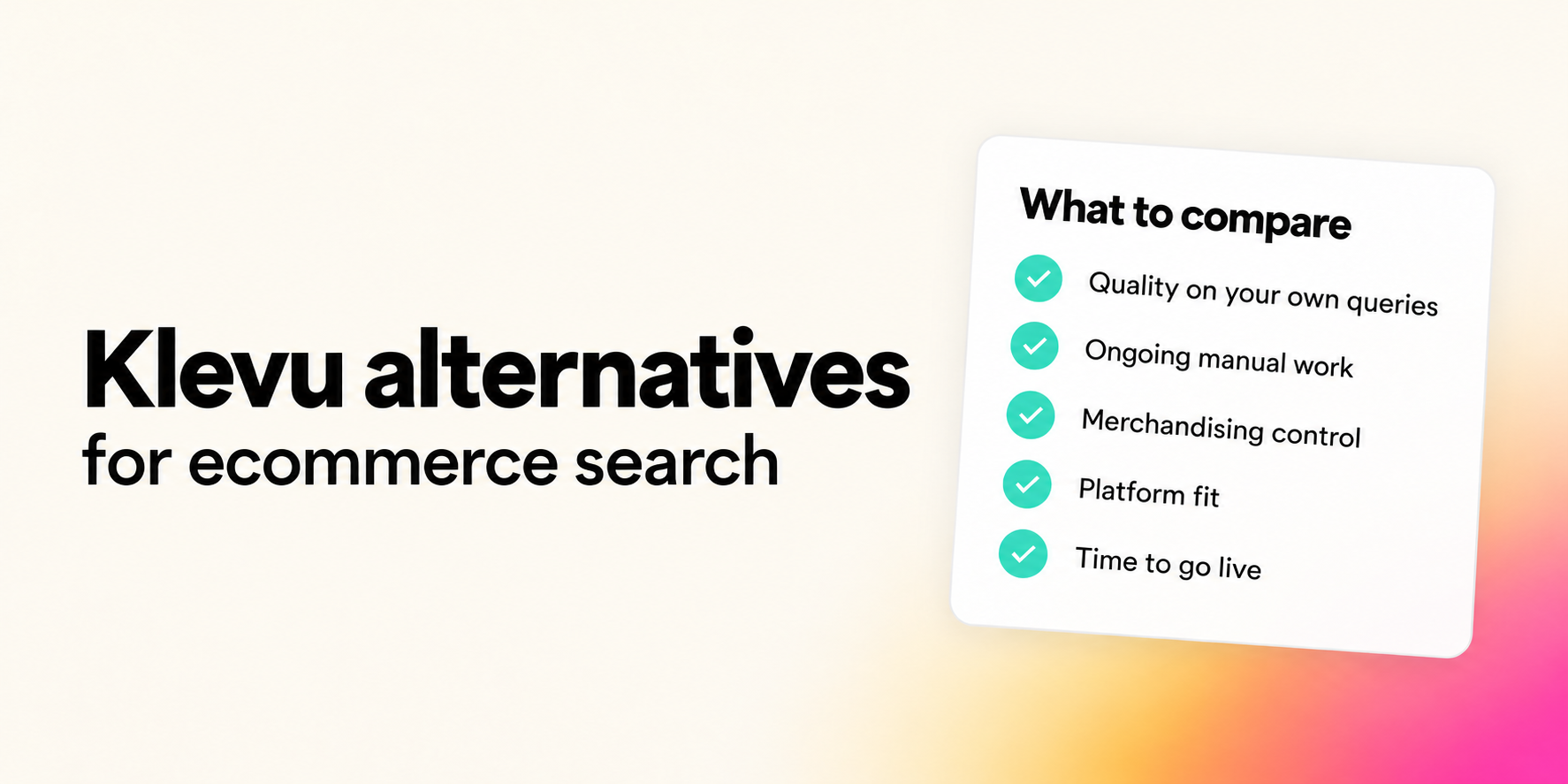
So here's what I'd score every option on:
- Quality on your queries, not the demo store's. Everyone looks great on a demo catalogue.
- How much ongoing work it needs. Does it learn, or does it need rules?
- Merchandising. Can your merchandisers set commercial priorities without a developer?
- What happens beyond the search box. Category pages, product pages, the homepage. Search and personalisation should share the same understanding of the shopper.
- Platform fit. Klevu built a following on Magento/Adobe Commerce as well as Shopify. Make sure your replacement is properly supported on yours, not "supported via API, good luck."
- Time to live. Weeks or months?
The best Klevu alternatives (a fair list)
Athos Commerce (Searchspring)
The path of least resistance. Same family, a documented migration path, and Athos has said contracts and pricing for the same features will be honoured. Searchspring has been around since 2007 and is well regarded, and the new platform bundles search, personalisation, merchandising and feed management. Worth a serious look, especially if you liked working with the Klevu team. Just go in knowing it's still a migration.
Algolia
Very fast, very flexible, and developer-friendly. There's a free tier and usage-based pricing for Grow plans, with custom pricing for Elevate. It shines when you have strong in-house developers. The flip side is that flexibility needs people. It's a big commitment.
Constructor
Strong in enterprise retail. Customers include Sephora, The Very Group and Monica Vinader, and it reported 82% customer growth and 96% gross revenue retention in its last financial year. A good fit for large catalogues and big teams. Expect enterprise pricing and an enterprise project.
Bloomreach Discovery
Search, merchandising, recommendations and SEO in one, with brands like PUMA and Canadian Tire. Makes most sense if you also want Bloomreach's marketing suite under the same roof.
Coveo
Built for large, complex setups: multi-region catalogues and combined product and content search. If you sell across lots of markets and need enterprise permissions, it belongs on the shortlist.
Boost (Shopify)
Popular with Shopify stores for search and filtering. One note: when I checked in October 2026, Boost's main Shopify App Store listing showed as "not currently available", so ask them directly about the current setup before you shortlist.
Shopbox AI
That's us, so take this section with the appropriate pinch of salt. More on it below.
How do you migrate off Klevu without losing ground?
This is the bit I'd actually print out. Whoever you choose, do this first.
1. Export what you can, while you can.
- Your top 500 search queries by volume, for the last 12 months.
- Your zero-result queries. This is gold.
- Search revenue and conversion by query, if you can get it.
- Synonyms and redirects (these export as CSV). Boost rules and analytics may not export cleanly, so screenshot the important ones.
2. Test on your own queries. Take your top 100 queries and your top 50 zero-result queries. Run each one on your current site and on each candidate's staging site. Score the first row of results: right product, close, or wrong. It's boring. It takes an afternoon. It will tell you more than any demo.
3. Don't rebuild your synonym list by default. This one's tempting, because it feels safe. But half of those synonyms were written to patch a weakness in the old engine. Run the new one without them first. Only add back the ones that actually fix a problem. You'll be surprised how few you need.
4. Check peak. Ask each vendor how they handled Black Friday last year. Response times, uptime, real numbers.
5. Run both side by side. Don't switch off Klevu until the new one has proved itself on live traffic.
6. Avoid Q4. If you can't be live and settled by early November, wait until January.
Where does Shopbox fit?
I'll keep this short. Shopbox is one engine for Search, Personalisation and Merchandising. Because it's one engine, not three tools bolted together, everything works together seamlessly and every shopper gets a personal store across every surface. The person who searched for walking boots sees relevant products on the category page, the product page and the homepage too, and your merchandising priorities apply everywhere at once.
Our view on search is simple. "No matter what you type, it finds something. We've got a policy: no zero results." And "you should never, ever need to touch the system". No synonym lists, no correction lists. Customers have seen a 90% reduction in manual search work, and some have never done any manual tuning at all. Toymate, an Australian toy retailer, found 90% of searches showed better results with no intervention than their previous engine, which had thousands of hours of work put into it over the years.
On reliability, Schuh has been with us for four years and just signed for year five. They do over 60,000 orders a day on Black Friday. Search response time is 150ms at P95, including the AI.
And on the bit Klevu customers have told me was weaker: we don't do simple recommendations. We do personalisation at an individual level. "We don't have personas, we only have people."
We work on Shopify, Shopify Plus, Magento/Adobe Commerce, BigCommerce, Salesforce Commerce Cloud, WooCommerce and custom platforms. On Shopify we can be live the same day on a copy of your store for you to review. Other platforms go live in a sprint. So you could run the six-step test above on us in a week, not a quarter.
The bottom line
Klevu is going away in its current form. That's not a crisis. It's a deadline, and deadlines are useful. You have to migrate anyway, so use it to pick the best option for the next five years, not just the nearest one.
Export your data. Test on your own queries. Don't drag your old synonym list along. And if you'd like to see how Shopbox handles your top queries and your zero-result list, book a demo. Bring the list. I'll show you live.
For more on how AI search differs from the rule-based kind, see AI-powered ecommerce search vs traditional search and the top 5 things you hate about ecommerce search.
FAQ
Is Klevu being shut down?
Klevu is now part of Athos Commerce, which said in August 2025 that "beginning in 2027, legacy platforms will be gradually retired" and that Klevu customers would get a migration path to the new Athos platform. In practice, Klevu customers will need to start migrating from early 2027, so now is the time to decide where you're going.
Who owns Klevu now?
Klevu combined with Searchspring in January 2025 to form Athos Commerce, a company backed by private equity firm PSG. Intelligent Reach, a product feed tool, sits in the same group. Klevu's products are being brought together with Searchspring's into one Athos platform, which launched at Shoptalk Europe in June 2026.
Is moving to Searchspring/Athos easier than switching vendor?
Probably a bit easier, because it's the same family and Athos has promised guided documentation and support. But Athos calls it a "migration path" for Klevu customers, not an upgrade. You'll still need to test results, check integrations and retrain your team, so it's worth comparing other options while you're doing that work.
What should I export from Klevu before I move?
Your top search queries, zero-result queries, search revenue by query, and your synonyms and redirects. Synonyms and redirects export as CSV. Boost rules and analytics may not export cleanly, so screenshot anything important. Your zero-result list is the most useful thing you have for testing a new engine.
What's the best Klevu alternative for Magento/Adobe Commerce?
Algolia, Constructor, Bloomreach, Coveo and Shopbox all support Adobe Commerce. Large teams with developers often lean to Algolia or Constructor. If you want search and personalisation that don't need ongoing tuning, test Shopbox. Whatever you pick, compare them on your own top queries.
Sources
- Klevu Joins Forces with Searchspring to form Athos Commerce — merger, PSG backing, Klevu 3,000+ brands, 13 Jan 2025
- Introducing Athos Commerce: Searchspring and Klevu Join Forces — deal closed 9 Jan 2025, "taking the key features from both platforms", contracts/pricing honoured, platforms (Shopify, BigCommerce, Adobe), 13 Jan 2025 (updated Apr 2025)
- Athos Commerce Updates Platform Rollout… Smooth 2026 Transition — Q1 2026 GA, "migration path for Klevu customers", "Beginning in 2027, legacy platforms will be gradually retired", 26 Aug 2025
- Athos Commerce Mid-Year 2026 Release and BusinessWire release — Intelligent Discovery Platform launch, "available immediately", 10 Jun 2026
- Klevu – Shopify App Store — Klevu still listed, checked 19 Oct 2026
- Shopbox analytics, 5–18 Oct 2026 — 7 retailers, bots excluded, revenue from checkouts matched to sessions: searchers converted a median 6x better than non-searchers (range 2.6–8.4x)
- Baymard: Ecommerce Search Query Types — 56% of sites fail to adequately support search needs; published Sep 2024, updated 29 Apr 2026
- Algolia pricing — free tier, usage-based Grow, custom Elevate; checked Oct 2026
- Constructor growth (eCommerceNews) — customers named, 82% customer growth, 96% GRR; 13 Mar 2026
- Bloomreach Discovery — capabilities, named customers; checked Oct 2026
- Coveo vs Bloomreach — Coveo positioning for large multi-region catalogues (vendor page); checked Oct 2026
- Boost AI Search & Filter – Shopify App Store — "not currently available on the Shopify App Store", checked 19 Oct 2026
Share: